
Case: Vendor Q&A
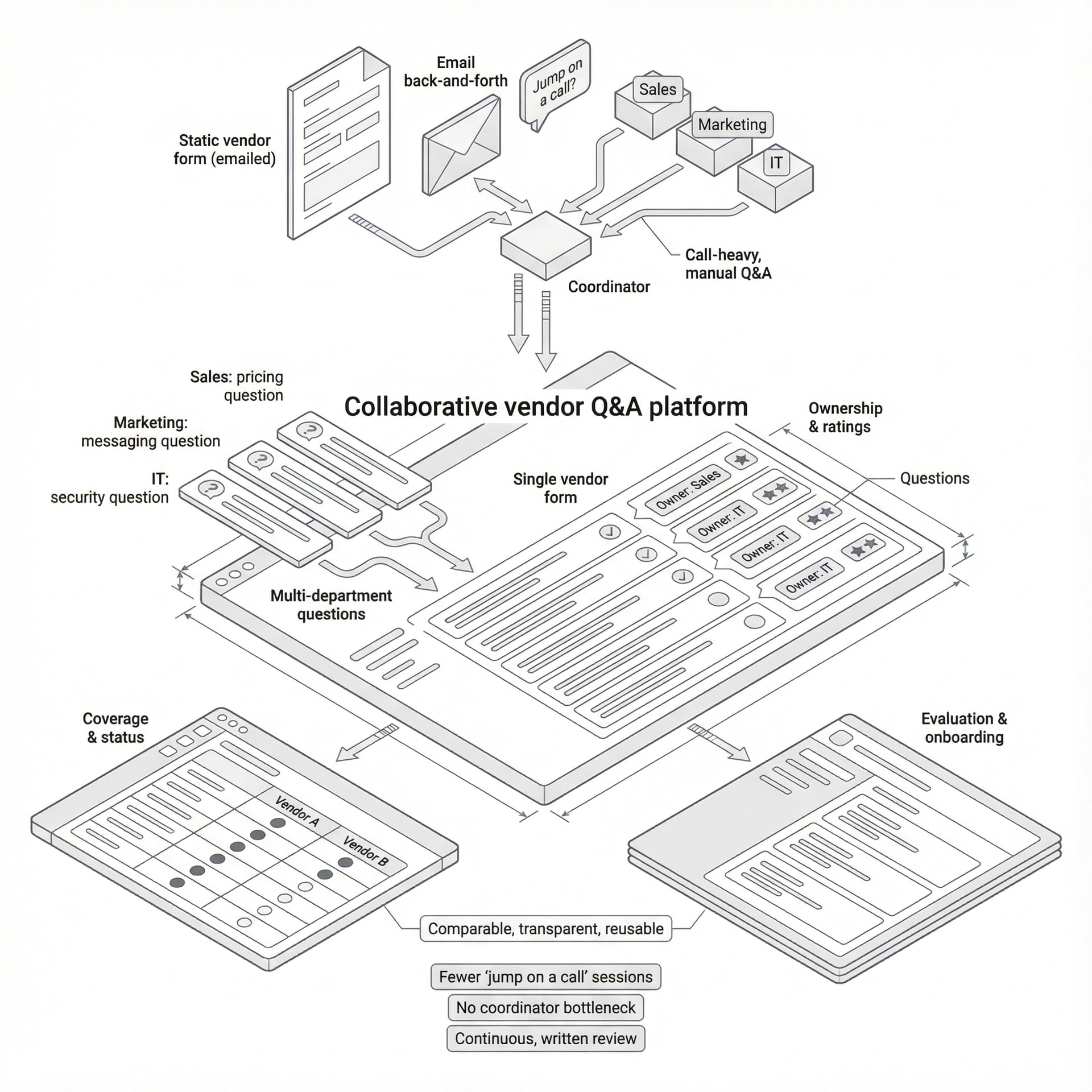
A procurement firm needed to tame chaotic, call-heavy vendor evaluations. We built a collaborative Q&A and evaluation platform that keeps everything written, comparable, and transparent across departments and vendors.
- Step 01
Context & starting point
- Mid-sized procurement/sourcing firm specializing in helping enterprises evaluate and select vendors.
- They coordinated multi-vendor evaluations where deal sizes were large and multiple internal departments (sales, marketing, etc.) had different information needs.
- A recurring problem was vendors insisting on “jumping on a call” for every clarification, turning routine Q&A into high-pressure sales conversations.
- Step 02
The internal tool (as we found it)
- Process centered on manually created forms (documents or basic form tools) emailed to vendors.
- One coordinator collected questions from all departments, updated a master form, and notified vendors of new or revised questions.
- Vendors often pushed back to calls but eventually filled the forms, triggering another round of back-and-forth when departments had follow-up questions.
- No shared, real-time view: departments had limited visibility into each other’s questions, vendor responses, or evaluation status.
- Evaluation was done via large end-of-process meetings where teams manually tallied feedback and discovered missing information late.
- Step 03
Why change / trigger
- High time cost and coordination overhead for the procurement team managing multi-vendor, multi-department Q&A by email and static forms.
- Vendors repeatedly steering communication to sales calls, undermining the client’s need for written, comparable answers.
- “Broken telephone” between departments: delayed follow-up questions, conflicting asks, and last-minute discovery of gaps.
- Existing form-builder apps still required a central operator, did not support dynamic departmental input, and were not designed for iterative vendor Q&A.
- Step 04
What we did
- Analyzed the end-to-end vendor Q&A workflow: question collection from departments, form creation, vendor responses, and evaluation.
- Identified key requirements:
- Distributed question authoring by multiple departments.
- Single consolidated vendor form that updates in real time.
- Versioning and change notification for vendors.
- Per-question ownership and per-answer evaluation.
- Designed a multi-tenant web application that:
- Lets each internal department log in and create, edit, and tag their own questions.
- Automatically merges all department questions into a single structured vendor questionnaire per opportunity.
- Tracks versions of the questionnaire and sends automatic notifications to vendors when new questions are added.
- Implemented UX patterns to reduce friction and push vendors to written responses:
- Clear deadlines and instructions at the top of each vendor form.
- Persisted state: previously answered questions remain collapsed but accessible; new/changed questions are surfaced prominently.
- Built notification and review workflows:
- When a vendor answers a question, the originating department is immediately notified.
- Departments can rate, comment on, and flag responses as they arrive, instead of waiting for a final review phase.
- Exposed transparent status views:
- Who asked each question.
- Which vendors have answered which questions.
- How each answer has been rated by the relevant stakeholders.
- Step 05
The new product
- A collaborative vendor Q&A and evaluation platform used by procurement teams, internal departments, and external vendors, now also repurposed as a core client-onboarding tool.
- Primary users: procurement leads (set up opportunities and vendors), functional departments (create questions and review answers), external vendors (respond to questionnaires), and new client organizations during onboarding.
- Main capabilities:
- Multi-department question authoring and editing, combined into a unified external-facing form.
- Real-time updates and versioning with automatic notifications.
- Vendor/client view optimized for incremental completion, highlighting only new/unanswered questions.
- Per-question ownership, instant departmental notifications on responses, and in-line rating/review.
- Full transparency on question coverage and response status across all stakeholders, for both vendor evaluations and new client onboarding.
- Step 06
Results & impact
- Dramatically reduced need for vendor “jump on a call” sessions by establishing a clear, structured written Q&A process.
- Removed the coordinator bottleneck: departments now ask and review their own questions directly in the system.
- Shortened evaluation cycles by enabling continuous, asynchronous review instead of large end-of-process meetings.
- Increased transparency and auditability: every question, answer, and rating is traceable to a department and vendor/client.
- Improved comparability of vendors’ responses, enabling more objective scoring and better decision support.
- The platform evolved into a key component of their commercial offering, used to onboard new clients and demonstrate a differentiated, structured procurement process.
- Step 07
Tech highlights
- Web-based, multi-user application with role-based access for internal departments and external vendors/clients.
- Real-time form aggregation and version tracking to manage evolving question sets per opportunity or onboarding engagement.
- Notification system integrated with email for external alerts and departmental response notifications.
- Data model designed around questions, owners, organizations (vendors/clients), responses, and ratings to support transparent evaluation and onboarding workflows.
- Step 08
Where we left them
- The procurement firm now owns and operates the platform as its standard tool for vendor evaluations and new-client onboarding, with ongoing internal enhancements.
- It is actively used across engagements and packaged as a central part of their value proposition to new and existing clients.
Collaborative vendor Q&A and onboarding platform
Shared, structured Q&A across vendors, departments, and clients. The firm turned a coordination headache into a core product that now powers both vendor evaluations and new-client onboarding.
We use a tight stack that balances speed, robustness, and long‑term maintainability.










Everything You Need to Know
Do we need a fully working tool before we talk?
No. It is enough to have a real internal asset: a heavy spreadsheet, prototype app, script bundle, or R&D tool that people rely on.
What if we only want an internal upgrade, not a product to sell?
That is fine. Many clients start with “make this safe, usable, and maintainable internally.” Productization for external customers can be a later step.
How long does the process take?
Typical ranges: Phase 0 is 4–6 weeks, and Phases 1–3 together usually take about 3–6 months, depending on complexity, integrations, and scope.
How much of our team’s time will this require?
We need access to 1–3 domain experts and a technical contact. Time is heaviest in Phase 0–1 for interviews and reviews, then drops to periodic check‑ins.
Who owns the IP when the project is done?
You do. All code, designs, and documentation specific to your product are yours. We only retain generic, reusable internal tooling and know‑how.
Can you work with our existing tech stack and team?
Yes. Our preferred stack is Django, Next.js, PostgreSQL, Redis, and AWS/GCP, but we can integrate with existing systems and coordinate with your internal engineers.
Is AI mandatory in every project?
No. We only add AI (Gemini, OpenAI, etc.) where it clearly reduces expert effort or user friction. If your data and processes are not ready, we will not force it.
How do we get started?
We start with a short call, and if there is a fit, a fixed‑fee Productization Assessment. You get a clear blueprint and options before committing to a full build.