
Case: AI-assisted RFP creation and collaboration platform
A software vendor selling into enterprise RFPs wanted to turn chaotic, document-based requirements into a structured, AI-assisted RFP creation product they could use internally and sell to customers.
- Step 01
Context & starting point
- The client is a software vendor that sells primarily through RFP-driven enterprise deals.
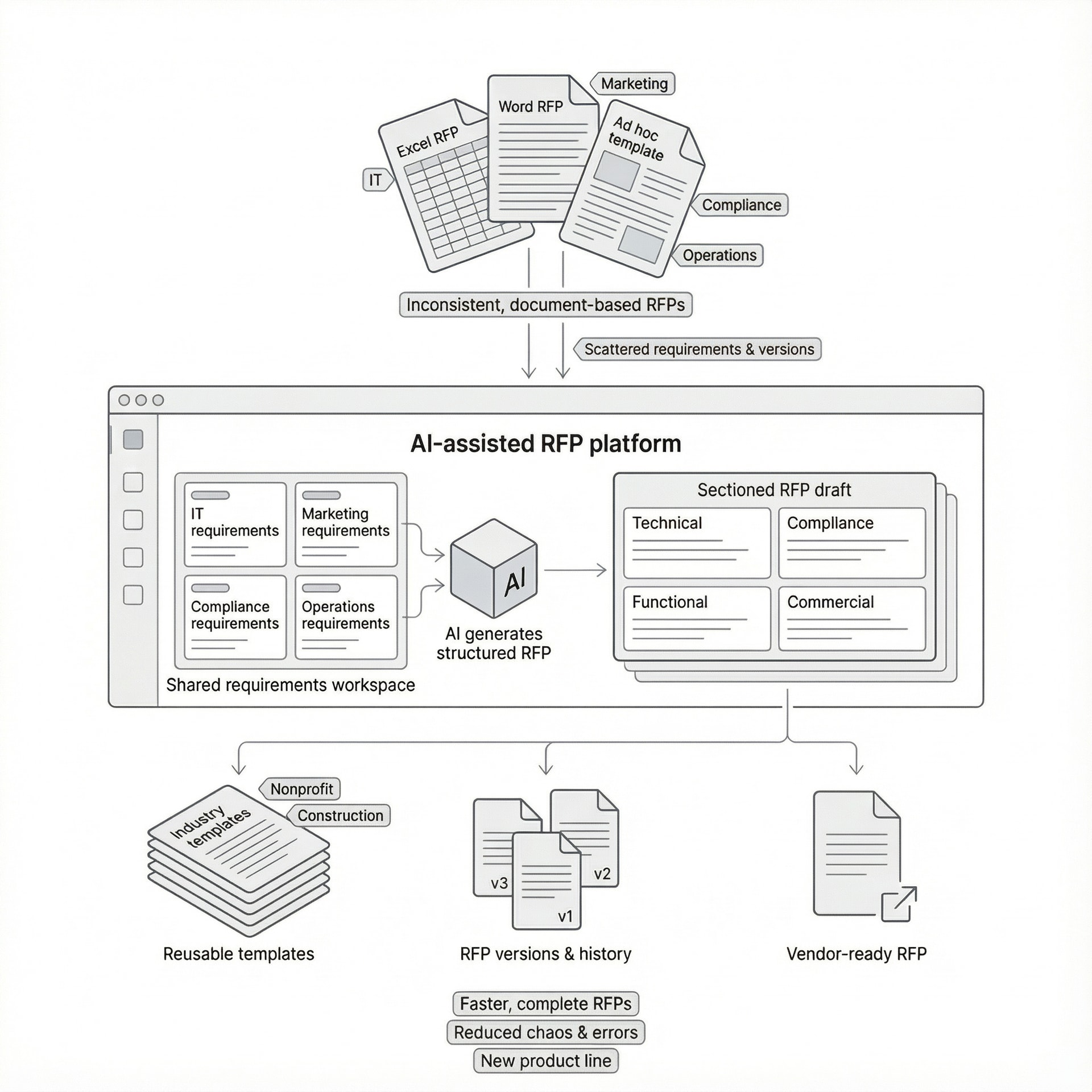
- Every prospect ran RFPs differently (Excel, Word, ad hoc templates), creating inconsistent, hard-to-navigate requirements sets.
- RFPs often spanned hundreds of pages, with critical items like compliance scattered throughout, making them slow and error-prone to respond to and hard for buyers to manage.
- Step 02
The internal tool (as we found it)
- Initially, there was no unified tool—RFPs arrived as unmanaged documents from prospects.
- Requirements from multiple buyer departments (IT, marketing, compliance, etc.) were mixed across large documents with no shared structure.
- Versioning was manual: edits and new requirements were tracked in document history or email threads.
- There was no systematic way to reuse past RFP structures or templates by industry or deal type.
- Step 03
Why change / trigger
- The vendor saw a recurring pattern: every customer was reinventing the RFP process in a slightly different, inefficient way.
- This created friction on both sides—clients struggled to assemble coherent RFPs, and the vendor spent time parsing messy documents.
- The company identified a product opportunity: an AI-assisted RFP creation platform they could both use internally and commercialize.
- Step 04
What we did
- Designed an application workflow where a buyer (or internal champion) starts by listing core requirements: certifications, integrations, timelines, permissions, compliance needs, marketing requirements, etc.
- Implemented an AI layer that:
- Ingests these raw requirement lists and departmental inputs.
- Generates a structured, comprehensive RFP document, organized into logical sections (technical, compliance, functional, commercial, etc.).
- Built collaborative features for multi-department input:
- Each department can log in and add requirements, comments, and clarifications in their own area.
- The system merges all inputs into a single RFP draft while preserving ownership and context.
- Implemented RFP versioning and change tracking:
- Any new or updated requirement creates a new RFP version.
- All adjustments are recorded with who made them and when.
- Finalized versions can be exported and sent to vendors.
- Added reusable templates and industry patterns:
- RFP structures (tags, sections, tasks, departmental roles) from a completed document can be cloned as a starting point for the next RFP.
- Created industry-specific template baselines (for example, nonprofit vs. construction) that pre-load typical requirements and structure.
- Step 05
The new product
- An AI-assisted RFP creation and collaboration platform now offered as a standalone product to the vendor’s customers.
- Primary users: procurement teams, department leads (IT, marketing, compliance, operations), and other stakeholders authoring RFPs.
- Main capabilities:
- Multi-department requirements capture in a shared workspace.
- AI-generated, fully structured RFP documents from free-form requirement lists.
- End-to-end versioning with detailed change history.
- Template cloning from previous RFPs and industry-specific templates.
- Exportable, vendor-ready RFP packages.
- Step 06
Results & impact
- Buyers can produce complete, structured RFPs significantly faster by aggregating all departmental requirements into one system.
- Reduced RFP chaos (scattered compliance items, overlapping questions, inconsistent sections) via AI-standardized structure.
- Easier iteration: new RFP versions are generated from updated requirements without manual document surgery.
- Substantial time savings for recurring RFPs through reusable templates and industry-specific starting points.
- The tool itself became a new revenue-generating product line, handed off to clients as a differentiating part of the vendor’s offering.
- Step 07
Tech highlights
- Web-based, multi-user collaboration environment with role/department-based access.
- AI engine (LLM-based) to transform requirement lists and comments into a coherent, sectioned RFP document.
- Version control and audit trail for requirements, contributors, and RFP document snapshots.
- Template system keyed on tags, departments, and industry types to support rapid reuse and customization.
- Step 08
Where we left them
- The software vendor now operates the platform as a standalone product, used both internally and sold to customers for their own RFP workflows.
- They continue to expand template libraries and refine AI prompts to support more industries and complex enterprise requirements.
AI-assisted RFP creation and collaboration platform
A structured, collaborative RFP workspace that turns messy, document-based requirements into reusable, AI-generated RFPs the vendor now sells as a standalone product.
We use a tight stack that balances speed, robustness, and long‑term maintainability.










Everything You Need to Know
Do we need a fully working tool before we talk?
No. It is enough to have a real internal asset: a heavy spreadsheet, prototype app, script bundle, or R&D tool that people rely on.
What if we only want an internal upgrade, not a product to sell?
That is fine. Many clients start with “make this safe, usable, and maintainable internally.” Productization for external customers can be a later step.
How long does the process take?
Typical ranges: Phase 0 is 4–6 weeks, and Phases 1–3 together usually take about 3–6 months, depending on complexity, integrations, and scope.
How much of our team’s time will this require?
We need access to 1–3 domain experts and a technical contact. Time is heaviest in Phase 0–1 for interviews and reviews, then drops to periodic check‑ins.
Who owns the IP when the project is done?
You do. All code, designs, and documentation specific to your product are yours. We only retain generic, reusable internal tooling and know‑how.
Can you work with our existing tech stack and team?
Yes. Our preferred stack is Django, Next.js, PostgreSQL, Redis, and AWS/GCP, but we can integrate with existing systems and coordinate with your internal engineers.
Is AI mandatory in every project?
No. We only add AI (Gemini, OpenAI, etc.) where it clearly reduces expert effort or user friction. If your data and processes are not ready, we will not force it.
How do we get started?
We start with a short call, and if there is a fit, a fixed‑fee Productization Assessment. You get a clear blueprint and options before committing to a full build.